Open banking and pay by bank, a practical guide for businesses weighing card alternatives
Payments that move straight from a customer's bank account to a merchant's promise lower costs and faster settlement. The trade-offs lie in consumer habits, protections and coverage.
Key takeaways
- Open banking rules in the EU and UK let licensed third parties start payments directly from a customer's bank account with the customer's consent.
- Pay by bank can cut acceptance costs and speed up settlement, but it lacks the chargeback protection that makes cards familiar to shoppers.
- Variable recurring payments and the EU's PSD3 and Payment Services Regulation package could widen use cases, with timelines still to be confirmed.
For most merchants, accepting cards is a cost of doing business that rarely gets questioned. Interchange, scheme fees and acquirer margins are folded into a single rate, settlement takes a day or more, and disputed transactions can be reversed weeks later through chargebacks.
Open banking offers a different route. Instead of pulling money through card networks, a licensed provider can, with the customer's consent, instruct the customer's bank to push a payment directly into the merchant's account. In Europe and the United Kingdom, regulation has required banks to open up access for these providers since 2018, and the arrival of instant payment systems means the money can arrive within seconds.
For businesses, the appeal is clear: potentially lower costs, faster access to funds and fewer disputes. The question is whether customers will use it, which payments it suits, and how rules in the EU and UK are evolving.
How open banking made pay by bank possible
The EU's revised Payment Services Directive, known as PSD2, applied from January 2018. It created two regulated roles that sit between customers and their banks:
- Account information service providers, which can read account data such as balances and transactions with the customer's permission.
- Payment initiation service providers, which can start a payment from the customer's account on the customer's instruction.
Banks must give these providers access through secure interfaces, and payments must be authorized with strong customer authentication, typically confirmed in the customer's banking app with biometrics or a passcode. The technical standards for authentication and secure communication applied from September 2019.
The United Kingdom took a parallel path. A 2017 order from the Competition and Markets Authority required the largest banks to build standardized open banking interfaces, and the UK's version went live in early 2018. Pay by bank in the UK runs mainly over the Faster Payments system, and in the euro area increasingly over instant SEPA transfers.
How a pay-by-bank payment works
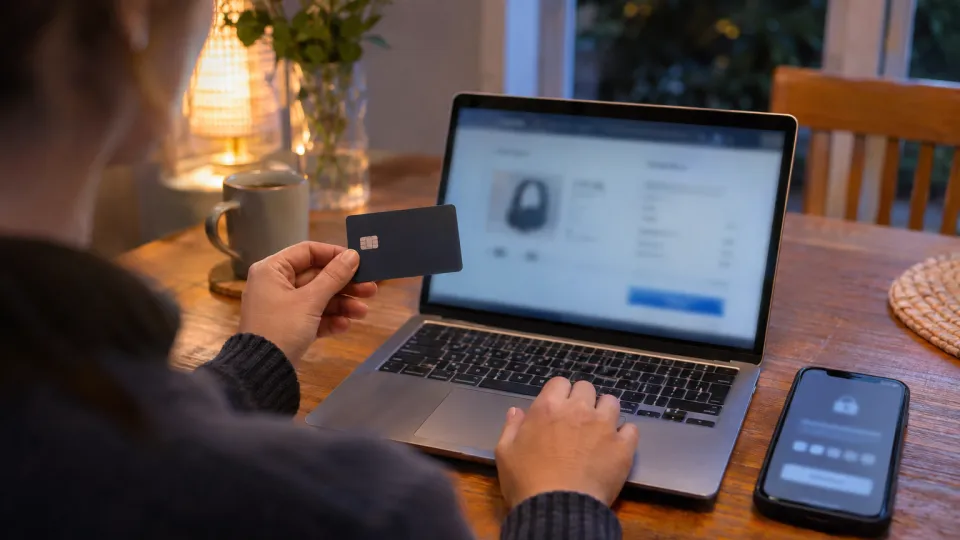
A typical online checkout runs in a few steps. The customer chooses to pay by bank and selects their bank. They are redirected to their banking app, where the amount and payee are already filled in. They confirm with their usual authentication. The bank sends the payment, and the merchant receives confirmation that it was initiated, followed by the funds, often within seconds where an instant scheme is used.
Because the customer never types card details or account numbers, the merchant does not handle sensitive payment data, and errors in payee details are largely eliminated.
Pay by bank versus cards
| Factor | Cards | Pay by bank |
|---|---|---|
| Cost structure | Interchange, scheme fees and acquirer margin, often a percentage | Provider fee, often lower and sometimes flat per transaction |
| Settlement to merchant | Usually one or more business days | Can be seconds over instant payment systems |
| Disputes | Chargeback rights for cardholders | No card-style chargeback, push payments are hard to reverse |
| Fraud model | Card-not-present fraud, managed by issuer and merchant tools | Strong authentication in the bank app reduces stolen-credential fraud |
| Recurring payments | Stored cards, card updater services | Direct debits today, variable recurring payments emerging |
| Customer familiarity | Very high | Varies by country and age group |
Pay by bank is cheaper largely because it strips out the protections that make shoppers comfortable with cards, so merchants have to replace that trust some other way.
Where it works best
Pay by bank tends to suit high-value, one-off payments where card fees are significant, such as invoices, tuition, rent, travel deposits and tax payments. It also fits account top-ups and business-to-business invoices, where buyers would otherwise make a manual transfer and the merchant would face reconciliation work. Our explainer on real-time payments around the world shows how the underlying rails differ by market.
Where it struggles
Everyday low-value purchases, cross-border sales and customers who rely on card rewards or credit are harder to win over. The absence of chargebacks can also deter shoppers buying from unfamiliar merchants. In the euro area, Verification of Payee and instant payment rules add assurance, as covered in our guide to EU instant payments and Verification of Payee, but they do not replicate card-style purchase protection.
Variable recurring payments
A standard open banking payment needs the customer to approve each transaction. Variable recurring payments, or VRPs, let a customer set up a mandate once, within limits such as a maximum amount per payment or per month, and then allow a provider to initiate payments within those limits without fresh approval each time.
In the UK, VRPs were first required for sweeping, meaning moving money between a customer's own accounts, for example to avoid overdrafts or to top up savings. Regulators and industry have since been working to extend VRPs to commercial uses such as utility bills, subscriptions and financial services in phases. For merchants, commercial VRPs could become an alternative to both stored cards and direct debits, with faster settlement and more customer control. Coverage and pricing were still developing as of 2025, so businesses should check the latest status.
PSD3 and the Payment Services Regulation
In June 2023, the European Commission proposed a third Payment Services Directive (PSD3) and a new directly applicable Payment Services Regulation (PSR) to replace PSD2. The proposals aim to improve open banking interfaces, give customers dashboards to manage the data access they have granted, tighten fraud prevention and extend payee name checks, and strengthen the hand of non-bank payment providers.
The European Parliament and the Council of the EU reached a provisional political agreement on the package in November 2025, after which the texts needed formal adoption. Application is expected to follow after a transition period, with the directive requiring transposition into national law. Final wording and dates may differ from the original proposals, so readers should check the latest status with the European Commission or the European Banking Authority.
The EU has also been negotiating a separate Financial Data Access proposal that would extend data sharing beyond payment accounts. For merchants, the payments package matters most for the reliability of bank interfaces, which has been a persistent complaint from providers under PSD2.
Frequently asked questions
Does a merchant need its own open banking license?
Usually not. Most merchants work with a licensed payment initiation provider or a payment service provider that bundles open banking into its checkout. The provider handles the regulated part of the flow.
Can pay by bank be used for business-to-business invoices?
Yes. Many providers offer payment links or invoice buttons that let a business customer approve a transfer in its banking channel, which reduces errors in payee details and speeds up reconciliation. Corporate approval workflows may require several signatories, which some solutions support.
Is pay by bank safer than cards?
It removes card numbers from the process and relies on the bank's own authentication, which cuts some fraud types. But fraudsters can still trick customers into authorizing payments, and recovering a push payment is generally harder than reversing a card transaction.
The bottom line
Pay by bank is a credible complement to card acceptance, not yet a replacement. Its strengths, lower costs, near-instant settlement and fewer data-security burdens, are strongest for larger and recurring payments where card fees bite and customers value control.
Businesses considering it should test it alongside existing methods, measure conversion and cost per transaction, and watch how variable recurring payments and the EU payments package develop. For companies building payments into their own products, our guide to embedded finance covers the wider landscape.
This article is for information and education only and is not investment, legal or tax advice. Rules, rates and market conditions change; check the latest position with a qualified adviser or the relevant authority before acting. Our editorial standards.